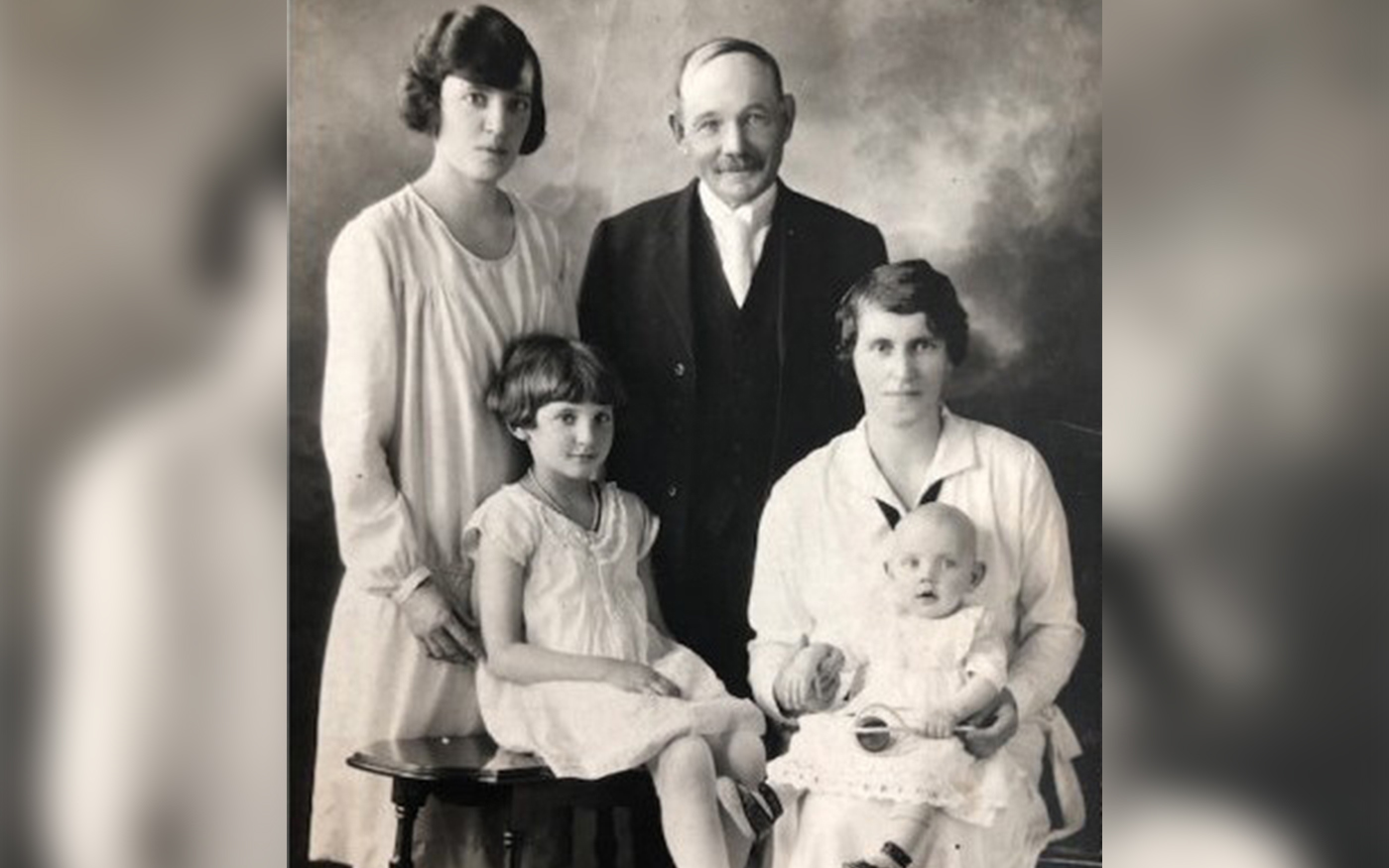
This Week in AG History -- July 9, 1921
Raised on a farm in Canada, Thomas Hindle (1870-1969) experience a life filled with hardship. He was the youngest of five children, and his widowed mother worked hard to keep them together. His school life was irregular due to needed farm chores. He often went to school in the winter months and worked on the farm during the summer. Because of this, his early education included little more than reading and simple arithmetic.
The Canadian winters were cold, and Thomas and his brothers constantly struggled to provide wood to heat their home. The boys had to work to help provide for the family’s needs. When he was 9 years old, Thomas began working on a neighboring farm, where he worked for his board and clothes. When he was 15, he went to live with a farmer for two years. He learned basic farming methods that later helped him on the mission field.
Thomas went back to school and proved himself academically. At age 19 he passed the entrance examination for Barrie Collegiate Institute in Barrie, Ontario. His schooling was interrupted when he ended up doing hard labor for several months in a rough camp for the Canadian Northern Railway. During this time, he learned lessons in self-discipline and getting along with others. After graduating, he worked several years as a schoolteacher. He continued his education and, in 1909, received a Bachelor of Arts degree with a major in science from McMaster University.
In the meantime, Thomas had become involved in the Hebden Mission in Toronto, which was a key congregation in the spread of the early Pentecostal movement in Canada. In 1907, at the age of 37, he was baptized in the Holy Spirit and was ordained by the Hebden Mission. In 1909, he married Louise Siegrist (1886-1964), who was a graduate of Bible Training School in Toronto.
Called into missions work, Thomas and Louise left for Hong Kong in 1909 without the backing of any missions board, and they continued traveling to Inner Mongolia in 1910. Inner Mongolia (now a region of northern China) was an obscure and isolated area that stretched between Outer Mongolia and China proper. At the time when the Hindles arrived, the local population was chiefly a nomadic tent-dwelling people who traveled from place to place seeking pasture for their flocks and herds. They endured cold, harsh winters and frequently encountered bands of robbers. Starvation and epidemics were common, and the people clung to local beliefs. Few westerners could survive living in Inner Mongolia.
The Hindles did their best to minister to the local population, learning the language, and adapting to the culture. They befriended their neighbors and won a few converts along the way. When war broke out between Mongol soldiers and a group of bandits, the Hindles had to flee for safety in Kalgan, China, without their possessions. A teacher lived in their house during their absence, and even though bandits had come twice at different times, their belongings were intact when they returned.
The Hindles affiliated with the Assemblies of God in 1914 and served as appointed Assemblies of God missionaries to Mongolia from 1918 to 1943. They experienced many hardships, including the death of three children: a new-born baby, 9-year-old Clifford, and their young daughter, Clara. They had three other children: George, Lillian, and Huldah.
Several times in their missionary service, the Hindles encountered robbers, but with prayer, God intervened in a big way. Once Hindle testified that a bandit chief with over 800 followers sent a letter demanding $500, a few ounces of opium, and several hundred skins. Hindle said to God, “It is You they are after, not me.” He assembled a band of Christians to pray. He was advised to take the children and flee, but he said, “No. God wants me to stand here, and here I die if need be.”
About the middle of the morning, Hindle heard that half of the bandits had left. He said to the Christians, “You have prayed half of them away, now pray the other half away.”
Shortly after praying, Hindle heard bullets being fired five times in a row, and very near their compound. It turned out that some Chinese soldiers had noticed the bandits. They got into formation to do battle, and then the bandits dispersed. This was an answer to prayer.
Another time Hindle reported, “At break of day, my wife called me to get up as there was an armed man in the yard. He was the leader of a band of over 20 armed robbers, and all of his followers were riding hard after him and coming straight for our house.” They prayed. And then the leader changed his plans and made a signal for the group to pass them up and go on to the next village.
But this was not all. The rear guard of five men continued into their camp. They asked for something to drink, so the Hindles gave them food and tea. Then this group of robbers said they wanted to hear the gospel. So, the Hindles continued on with their morning prayers, and then Thomas shared the gospel with them. He told them that Jesus loved them and He died to save them from sin. He also said that people who trusted God were not afraid to die. The Hindles then sang hymns in Chinese.
This seemed to touch the hearts of the men, and they rode off like gentlemen. One man’s hat blew off, and Hindle returned it to him, saying that Jesus loved him. He was startled by the reply: “Yes, and I love Jesus, too.” He could tell the man meant it, and this seemed to be a turning point for him to quit robbing, and to commit his life fully to God. He invited the man to come back to the mission, and he would tell him more about Jesus.
The Hindles returned for their first furlough to Canada in 1916. They served two additional terms in Mongolia and returned for a third term in 1939, but the Japanese had taken over the country, so they were not allowed to enter. They instead ministered at Truth Bible Institute in Peiping, China, where Louise was matron, and Thomas was acting principal.
Upon the outbreak of World War II, the Hindles were arrested and endured five and a half months in a Japanese concentration camp. Thomas was 73 years old at the time. They were freed from the camp in December 1943 and repatriated to Canada. After this, they retired to Woodstock, Ontario.
Early in their missionary work, Thomas and Louise Hindle sensed God impress Psalm 126:6 on their hearts: “He that goeth forth and weepeth, bearing precious seed, shall doubtless come again with rejoicing, bringing his sheaves with him.” The Hindles endured deprivation, death, and suffering in their missionary work. They had given their best to help the people of Inner Mongolia, and they learned to trust in God’s provisions and to live by faith.
Read “Surrounded by Robbers,” on page 29 of the July 9, 1921, issue of the Pentecostal Evangel.
Also featured in this issue:
• “The Gift of Tongues,” by Hermon L. Harvey
• “Divine Healing,” by Samuel M. Croft
And many more!
Click here to read this issue now.
Pentecostal Evangel archived editions courtesy of the Flower Pentecostal Heritage Center.